Subscribe

Subscribe to our monthly newsletter featuring interviews and insights.

Practice

ÉTEL Design Consultancy is a creative consultancy and design studio founded by art director and photographer Maurits Peeters. Its international clientele understands the power of effective communication through outstanding, considerate design. For them, we define, design, and apply their identity in the right context. The primary objective is always to move with clarity and create a timeless, elegant appeal, engage key audiences, and enable brands to become platforms that transcend their status quo.


Throughout our practice we act with awareness for aesthetics and detail, tried and tested expertise in design, luxury, technology, and social matters, and the agility that allows us to adapt rapidly to new environments, people, and objectives in the context of an ever-changing world. Pragmatism prevails to strike the required balance between desire and applicability. Thereby we aim to be good listeners and try to determine the essence of each brief and each conversation. Finally, we bring candor that respects the stakeholders in each project.

Services

Art Direction / Identity Development & Design / Concept Development / Creative Strategy / Copywriting / Online strategy / Web Design / Content / Narration / Editorial / Packaging / Spatial Design

Portfolio

Upon request, we share our extensive portfolio of recent work. Click here to request our portfolio via email.

Associates

We are always looking to connect with talent from all over the world. Whether in graphic design, photography, architecture, set design, videography or strategy. Feel free to at any time reach out via email to get in touch: maurits@eteldc.com


We occasionally take on interns for periods of five to six months.


To apply for an internship, email your CV together with a letter and PDF portfolio (maximum file size 6MB) to maurits@eteldc.com. Please extend clearly on your fields of interest, motivation, your expertise, and the role you are interested in taking on. Please submit files with proper file names.


Clients

ZENOLOGY, Mona di Orio, Pantomime Parfums, Just an Idea, Diptyque, DIOR, Carpenters Workshop Gallery, Chalming & Co, NAMAM, MENDO, CameraNu, Universal Music, Restaurants Caron, Three Ace Real Estate, Randstaete Participaties, OWNIT, Makers Avenue, Content Icons, Next Icons, W Hotel Rome, ModusBPM, Florinvest, Jesse Jewelry

Pieter Ceizer

Paris, February 2024


Pieter Ceizer is a Dutch artist living and working in Paris. For over 10 years he has rooted himself in the French capital and amassed a loyal audience of collectors and collaborators.


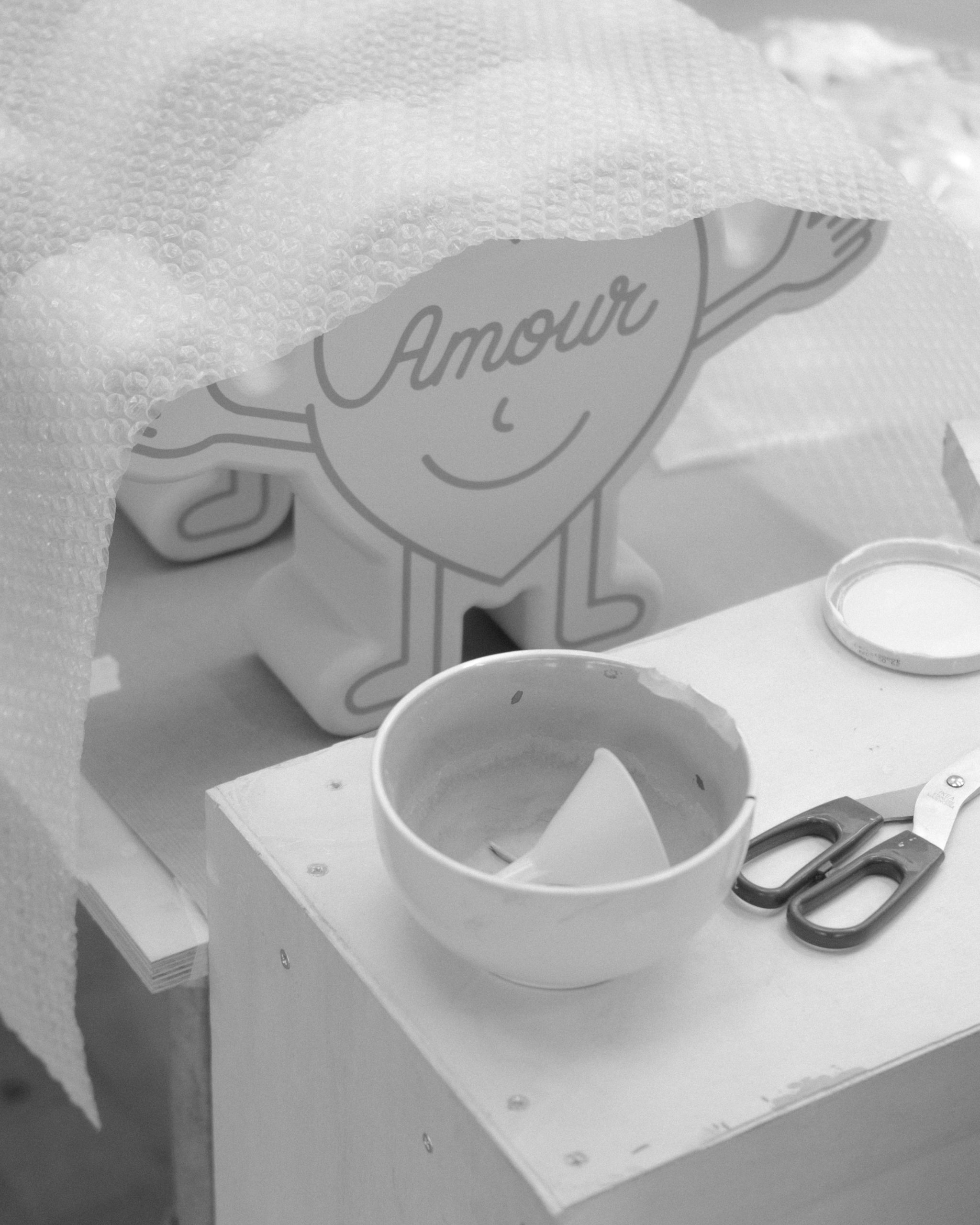
Pieter’s work is recognised for making abstract shapes form letters, turning calligraphically written words into bright poetic and often abstract universes. And then there’s the collection of what is by now a very decent-sized family of ‘woodies’; wooden figures that carry a softly spoken, but strong message to the world.
Among those he has collaborated with are some of the world’s most established brands like Colette, Evian, Coca-Cola, Paris Saint Germain, Mizuno, Heineken.


What sprung from indulging in the Amsterdam skateboard and graffiti scene in his early teen years, has by now grown into a flourishing career as independent artist, walking to the beat of his very own drum.


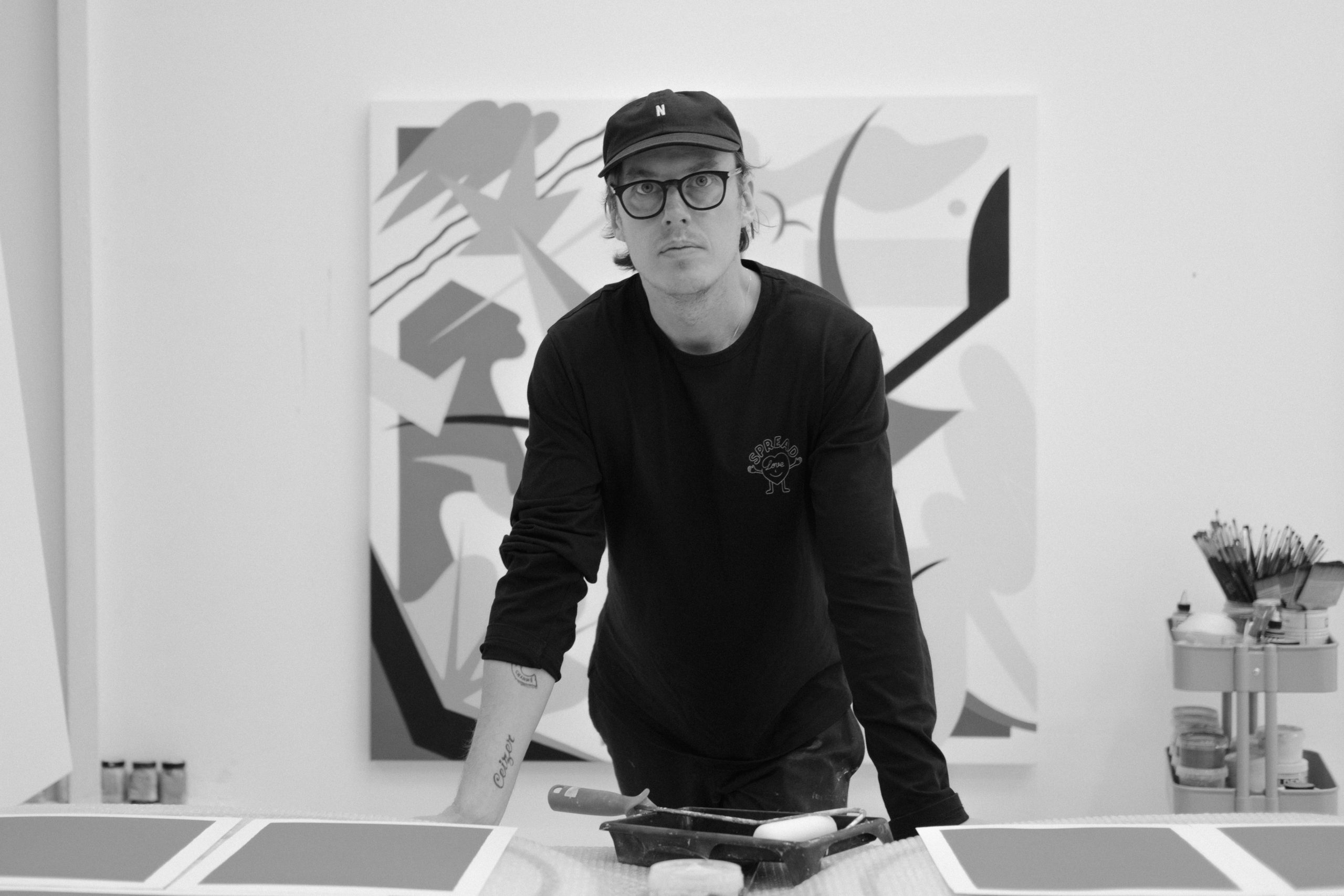
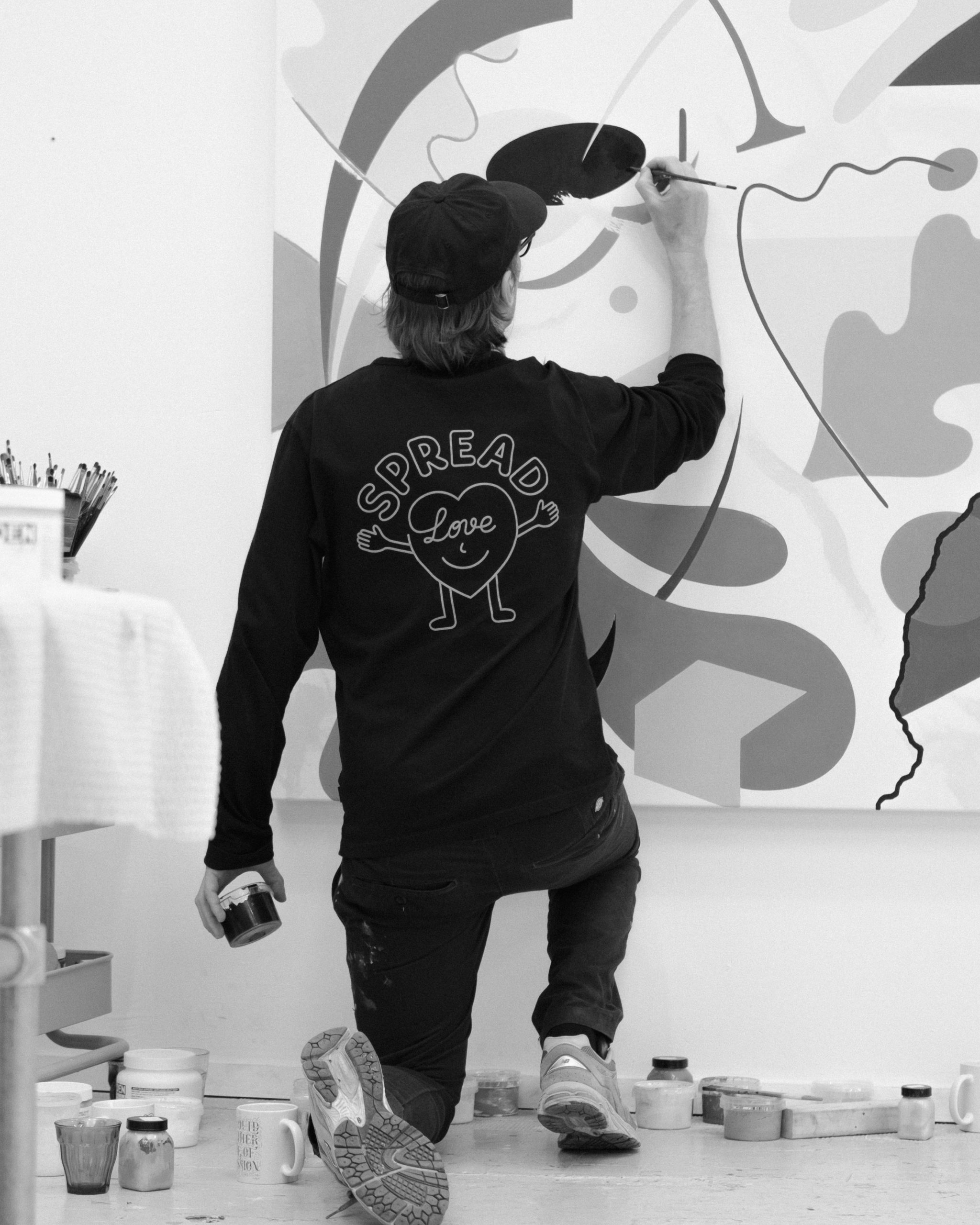
We meet Pieter in his atelier. A space that occupies more than 140 square metres in the Parisian suburb of La Courneuve. It is this sanctuary that his ideas inhabit and live freely in.


Pieter, your work is bright, colorful, and optimistic. One could say that’s also who you are as a person. Is that the case?


Pieter
Yes, I believe my work truly represents who I am, but I don’t think it’s just about the work itself, per se. It’s more about how you see it—as a reflection or a projection. It’s like, you have a certain energy, and you immediately reflect that. Or you project a certain energy or something you desire. Perhaps for me, it’s more of a projection than a reflection. My optimism has been shaped by my pessimism. As a child, I was often angry, discontent, and frustrated.


Over time, I transformed that into a more optimistic form. It’s like when you enter a place and tell yourself how nice it is. It will genuinely start to feel wonderful. And if you enter with the mindset of, “This place is terrible,” then it becomes just that—terrible. So, yes, I consciously choose, or at least I try to, to look for the light in every situation or every day, to focus on the positive rather than dwell on what’s wrong.


But then there are people who choose to enter every space with optimism, and then there are people, or at least a few, and you are definitely one of them, who are so dedicated to that mission that they choose to make it their life’s work to translate it into objects, and in your case, art.


Pieter
So, I see it this way: what I’m projecting is essentially the concept of an optimistic world. It’s about envisioning a world that doesn’t actually exist—a utopian dream world if you will. It’s more a place of hope where you’re completely detached from reality. That’s what I try to encapsulate in my work.
I believe that part of the purpose for viewers is to contribute something, to make everything a bit better. In my view, art doesn’t have to be overly serious. It can be something easily digestible.


Imagine something light-hearted that you might read, a cartoon, in an empty moment, in the bathroom. It gives you a brief moment of laughter, an amusing thought, a good quote, or a short but engaging storyline.


Then, you continue with your day, but it’s slightly improved. That’s how I view art. I don’t claim to have all the answers to life’s questions, but perhaps I offer just that bit of optimism to make everything more bearable. I believe that’s the role of my work.


Your work seems to ignore the dark sides of reality and zoom in on color, simplicity and abstraction. Or rather look at the world through color, simplicity, and abstraction. Where are the ideas for your creations born? And how do they come to life?


Pieter
Well, to some extent, acknowledging the darker side of reality means… by saying or doing very positive things… you also highlight the negative aspects, right? For instance, you could say, (looks over to his wife at the end of the atelier) what’s the song again, ” Le Ciel est Bleu,” right?


Camille (Pieter’s wife)
Le Temps Est Bon


Pieter
“Le Temps Est Bon et Le Ciel est Bleu” this phrase alone, when written down or shown to someone, triggers a multitude of thoughts, doesn’t it? On one hand, it evokes a sense of boundless optimism. Yet, I immediately think, ’this isn’t true’. You know, it’s like having the worst day ever, and then you step outside, you tell each other, “The sky is blue, and it’s a good time,”. It’s about flipping everything on its head, just saying “screw it,” and challenging it. So, it’s kind of a natural counter-reaction as well.


Literally creating your own reality.


Pieter
And a sort of counter-reaction, I would say.


Perhaps that’s what you’re doing, envisioning your own reality and creating things that confirm that reality you’ve envisioned, bringing them to life. Essentially, these objects remind you of it.


Pieter
One of the greatest joys for me is indeed to create something that, metaphorically speaking, almost becomes a person. You have an idea, a vision of what something looks like, or a word, composition, or image—just one—and bring that to life. And sometimes it’s also just very funny, it really is… My work is definitely about enjoying what you do and having fun with the creative process.


It’s fun to bring those big ideas to life. Sometimes you wonder, “Should I really be doing this, do I want to give this such importance?” and then you think, “I do”. I find a lot of joy in that.

Pieter Ceizer

How do the ideas for your work come to you, and how are they brought to life?


Pieter
Yes, there are various methods, but I’m always doodling down words or phrases. Sometimes, an idea just pops into my head, or something I overhear, or a conclusion I draw from a conversation with a friend or someone. That’s how I continuously make notes. Similarly, I doodle forms—shapes that originate from letters, kind of like fantasy landscapes or forms based on typography. They are graphic notes, basically. I’m constantly exploring new shapes and concepts through these graphic notes. My abstract work is essentially a collection of these notes combined into a cohesive piece.


So I would say creation happens playfully by constantly writing things down, sketching. Essentially, it’s a bunch of fragments of ideas, and I have sketchbooks full of notes and not-so-great ideas. And then sometimes, there’s that one thing that catches my eye, and I think, “Hey, that’s pretty cool.”
I create without pressure. If I try to force creation, it goes wrong. You shouldn’t try to force anything; you just do what you feel like doing. And when you’re really in tune with that—that vibration of freedom, you can easily scatter ideas around. And then you’re not judging them as “this is beautiful, this is good”; it doesn’t matter.
When you just let your imagination run wild and have fun with it, occasionally, one or two ideas stand out, and I’ll want to communicate or show them; bring them to life.


With the risk of sounding cliché, would you say you have a strong grasp on your intuition?


Pieter
I hope so. At least I’m always trying to follow my intuition. I think I’m constantly consulting my daydreams and intuition about being, or whatever is happening, or whatever I’m doing. That seems to be the path to everything. The people you surround yourself with, and the choices you make, all boils down to intuition in every aspect—be it design, art, business, or whatever.


But it’s crucial not to try too hard, as I mentioned before. Tuning into that vibration where you can truly be free is most important to me. If I start to overcalculate, it all becomes too calculated and strategic.


That said, having some structure can be helpful, but I’m not one for rigorous planning. I tend to live from one moment to the next, letting life unfold. For instance, I don’t know what I’ll be doing in three months. I don’t even know exactly what I’ll be doing next week. I only know I’ll finish this particular work, then probably another one similar to it. And I have an idea for a print. Those are two things. And then I have hundreds of other ideas but those circle the air until they have space to land. I don’t really have an agenda or a game plan for hitting this month’s revenue. We’re just always working; something is always happening. So it’s more about how things happen than following a must-do list. If you’re continuously active and you have a certain formula where such freedom works, then it can also be good.


It’s not that I’m just messing around, and everything magically falls into place; that’s not it. A certain discipline is involved, but then again, it all must result from a creative existence, not from a business focus on revenue or something like that.


Graffiti played a significant role in your formative teenage years. What led you to start with graffiti and then transition to graphic design and art as your life’s work?


Pieter
Around the time when I was 10 or 11 years old, that’s when I got into skateboarding. There were these guys at the halfpipe near Museum Square who were doing their pieces, and that’s what sparked my interest, like, “Wow, I want to do that too.” So, I started trying it out at home, practising a bit. And then, I also began doing my own scribbles out on the streets. That’s how it all started for me.


Looking back, we know that many of those involved in graffiti, or at least some of them, have become celebrated artists or designers. How do you view this development? Do you see it as logical?


Pieter
Reflecting on my early fascination with skateboarding, graffiti, and lettering, I recognize how much the scene has evolved. Initially, it felt like these interests were just in their infancy, often leading to the police station rather than toward a viable career path. Nowadays, the landscape has dramatically shifted. Young skaters now dream of turning pro, getting sponsorships, and achieving fame and fortune on Instagram, things that were unimaginable previously.


Back then, the number of professional skaters in the Netherlands was close to none, and hardly earned a living. Similarly, graffiti was just beginning to gain traction, with only a few artists managing to showcase their work. The idea that one could build a career from graffiti or streetwear was far-fetched. However, the influence of someone like Virgil Abloh has transformed our perception, showing us that street-inspired art and fashion can influence to the heights of luxury brands like Louis Vuitton and Gucci. This represents a significant shift, marking a new era where street culture is not only recognized but celebrated across the globe.


I’ve always sort of believed in the potential of what we were doing, viewing it as a new movement that, much like Pop Art before it, introduces fresh perspectives and possibilities into the art world. Despite the challenges of establishing a business model for such unconventional paths, the ongoing passion and creativity within these communities continue to drive the culture forward, inspiring the next generation to break down the boundaries and establish new realities in art and fashion.


Did you feel like you were part of a group that was influential?


Pieter
No, not really. As a kid, you’re just deeply immersed in what you’re doing and constantly dreaming about it. But it wasn’t about envisioning a future career in it. I was more focused on immediate goals, like pulling off a kickflip over a funbox next week or planning to tag near Amstel Station over the weekend. That was how far ahead I was looking. I could dream endlessly about these things. It was only later that I began to see that guys were becoming artists, and everything started to fall into place. It became apparent that the skate culture and activities surrounding it served as a blueprint for the future, though I wasn’t aware of it then. I just thought of it as a way to pass the time, not realizing it was laying the groundwork for my career. Even now, at 40, I still feel very connected to it all. I look essentially the same, with sneakers, a cap, and a hoodie, just as I did at eleven. I never thought I’d still be this way at 40; I imagined I’d become something more conventional, but that transformation never happened.

Pieter Ceizer

So what’s that blueprint?


Pieter
That’s a good question. It’s a mix of freedom and rebellion, defiance and an insistence on doing what we want, regardless of others’ expectations. It’s almost a life motto: no matter what, we’re going to do it, even if it seems futile or nobody’s waiting for it. If we’re told we can’t, we do it anyway. And I think what ties graffiti and skateboarding to my current life is perseverance. If you place a bad tag or a throw-up and people label you a “toy,” it’s fine. I’ll be back next week and the week after that, and the week after that. In three years, they’ll recognise me. When I was thirteen, at school, maybe initially, people thought, “Who is this toy?” but eventually, they saw me everywhere, on every tram and street. With skateboarding, I started off as a nerd, basically ousted, but by the end, I was part of the crew. So it’s all about persistence. It’s not about skill or talent but the mindset of showing up, regardless. I support the kids who start skating, just as cool guys supported me when I was a nerdy eleven-year-old, teaching me foot placements and tricks. They were incredibly supportive, and I try to pass that on. Sometimes, I see young people or others, and I think, “This seems off,” but I’d still want to guide them. That mindset is part of that blueprint. You don’t need skill or talent initially; what matters is your attitude. If you’re committed, painting a few throw-ups or painting pieces every weekend, you’re going to become a great graffiti artist, regardless of the quality of your work. Consistency makes you great. The same goes for art, fashion, and everything else. Persistence is key; talent is overrated. Many can draw beautifully or have a great idea, but what does that matter? Everyone has a good idea or wants to start a company, but it’s about actually doing it and keeping at it, even if you fail. Keep trying and see where you end up. It doesn’t matter what the outcome looks like, as long as you’re taking action. That’s the trick.


And then, suddenly, you’re 10 or 15 years down the line.


Pieter
Well, depending on how you look at it, but let’s say 30 years down the line.


Who were the early artists who inspired you, and which artists inspire you now?


Pieter
The very first ones were people from the graffiti scene. Especially the one around Museumplein. There was Sender, Zedz, Cece, Pone. Quite a lot, actually, but those four, for sure, and then a bit later, Brush. They were the reason I wanted to do all of this.


Nowadays, I draw inspiration quite differently than before. I’m inspired by anyone who has found their path. It’s inspiring to see people who have found their way or their style. I don’t necessarily have to like the same things. I find it amazing, I can appreciate something because I see that person has found their direction. That’s where the beauty lies for me, more than the aesthetic itself. So now, it’s hard to say, but there are so many sources of inspiration. For attitude or life philosophy, for example, Jan Cremer is important to me. He’s this self-made person who isn’t afraid to put himself out there, doing it with a good dose of humor and perseverance. That approach, for me, is admirable. And then, his use of color, I’ve learned a lot from looking at his colors.


Aesthetically, for example, the works of Liechtenstein from the 80s, not so much the comic works, but beyond that. I like a lot of American art, the obvious names, but I find Keith Haring incredibly cool because it’s so simplistic and universal. That’s a value I’ve learned a lot from and come to understand. You can dive deep into a subject, become a mega specialist in something no one else gets, which is impressive in its own right as a material or art expert. Or, you can simplify things to something everyone understands, which is universal. Both values need to exist side by side for me to create something meaningful. Keith Haring is a great example of this; his work seems playful and simple but is incredibly smart, analytical, and well-thought-out. He looks at a situation three times and then reflects that in a drawing that everyone can agree with, representing the world or the future. That’s genius and something I greatly admire. It’s difficult because there are so many names, and mentioning just a couple feels almost defining in a way I find corny, but they hold a lot of value for me.


There’s also, for typography, definitely Herb Lubalin. Looking at his body of work as a typographer and letter artist, you’d just want to give up. He’s done everything you could imagine and ten times better decades ago, he’s played out that game. His aesthetic and work are just of unmatched quality, and I, along with everyone else, can only aspire to that level.


So despite saying that everyone might as well pack up and not bother starting, you still started. That’s the rebellion, isn’t it?


Pieter
Exactly! Like, okay, he might be the coolest, but screw it. We’re going to do it even cooler and see if we can contribute something.


What’s a recent milestone for you? When I ask about recent milestones, what comes to mind?


Pieter
The coolest moment was when I moved into this atelier. I’ve always had just a small table, worked in my living room or bedroom or had a small office somewhere but never really… I’ve always dreamed of a cool space where I can do whatever I imagine, and now we’re here. When it was empty, it felt like a hall, but now it’s already filled with things; it has become a place. When I got here, I thought, screw it, I’m just going to do this, you know, and I knew it was a huge risk and a big responsibility right away. I asked my wife if she would help and work with me, leaving her job so we could dive fully into this. And that was amazing, that she decided we’re just going to do this, our way, wherever we want. And now, five years later and counting, it has become our life and we’re living this.


You mentioned taking a risk. You’ve previously stated you can only plan three months ahead at most. Somewhere in the back of your mind, there must have been something telling you that taking this risk was possible. You believed there was a chance of success. What were made you convinced enough to make the leap?


Pieter
I always see the possibilities in everything. So, I guess I have a lot of confidence in myself and in others. If I see someone who’s a decent photographer, I think, “This person is going to be the best photographer in the world.” I believe that if there’s an opening, there’s a possibility. And if there’s a possibility, there’s an opening. Haha. There’s an opportunity to make something happen. If it goes wrong, you can always go back.


It would have been safer for me to just stay at my little desk in my small space and keep going because things were going super well. But then it comes to the question of how you want to develop. If you want to create bigger works or more diverse works, you need more space, a workshop. I, as a creator or artist, want to grow. At that time, things were going very well financially, so it was like, if things are going great now and I want to grow and become a better artist, person, and creator, then I need to expand. Otherwise, I’d stay in my comfort zone, maybe earn much more and chill, or slowly fade away. So, I was like, let’s do the best we can, right?


You grew up in Amsterdam and moved to Paris at the end of your twenties. Why Paris? And how has the city influenced you?


Pieter
Paris all started as a kind of trip to sell t-shirts. It was an exciting adventure to sell my first shirts here, and then I just loved the energy of the city. Because it’s pretty big and a lot happens. There werer all these artists, awesome museums and many cool shops at the time, and still. Many music scenes, parties, openings, releases, etc., so it’s a very vibrant city. For example, even when you’re just waiting for the metro, there’s a new one every two minutes, and the one I get on is full, but the one two minutes later is full as well, and the one after that, and the one after that, and that’s just line 7. There are twenty more lines and hundreds of other stops. I just find that that energy is awesome; it just keeps going. I think it’s the centuries-old tradition of artists in Paris that creates a kind of magnetic pull that really hangs in the air here. I was just, or am just, enchanted by it, and that intuition of “Okay, I need to stay here.


In your collaborations with brands, what makes a collaboration successful?


Pieter
A successful collaboration happens when two parties come together and something new emerges as a catalyst for the process. It’s enriching when a partner introduces a new pace, way of thinking, or material. For example, working with Uniqlo allowed me to design t-shirts for a much larger audience than before. Or, being given a small piece to work on, like a bottle with specific dimensions and branding, forces you to creatively work within those new boundaries, enriching your approach. What’s crucial is that the collaboration brings new challenges and possibilities, pushing you out of your comfort zone. But if it’s just about doing something I already know how to do, like painting another square canvas, that’s not truly a collaboration. Finding a new formula, like working on a uniquely modified refrigerator, for instance, can lead to exciting new creations.


Have you ever experienced what writers call “writer’s block”? Do you ever have a creative block?


Pieter
I was all about needing a cool atelier where I could create amazing stuff. When I first got into this one, I was going to collaborate with Camille, my wife, so we could do even more amazing things together, given her skills in graphic design and photography. But once everything was set up—my table, my shelves, my books—I couldn’t create anything for the first six weeks. Suddenly, everything was perfect, I had that atelier I had dreamt of and all the pencils, markers, canvases, brushes, and so much space. It was overwhelmingly suffocating. It’s like, “Okay, you have everything you need to create great stuff. Now go create.” And then, you’re too scared to start. I eventually had to admit to my wife that I hadn’t created anything in weeks, and I just couldn’t. She told me to just let it be, and eventually, one design came out. She saw it, let me be, and realized I had found my moment and dared to draw again. Only when I finished that piece I remembered I had that block, from that moment on it never really occurred in such a way. I do always need to recharge. If I’m working on a new painting, for example, I’ve been thinking about it for weeks, making notes, imagining it in my head. It has to land at some point, and then I can create ten things in a burst. Then there might be weeks where I don’t make anything, just recharging. If you have nothing to say, you need to live a little or recharge somehow.


What do you hope people take away from looking at your art?


Pieter
I hope it sparks imagination, really. Imagination enriches. But that can be in any form. I’ve been approached by someone who started a garage after being inspired by one of my phrases. Or something else entirely different. It doesn’t have to be literal, like drawing letters—if you enjoy that, by all means. But being inspired to do something entirely different is perhaps even more special. It can activate a universal force, like “I saw this, and then I became a DJ,” which I’ve also heard. I find that a compliment.


Do you ever feel vulnerable?


Pieter
Vulnerable?


Yes.


Pieter
Yes.


When do you feel that way?


Pieter
Constantly, but do you mean a specific sense?


I imagine presenting your work to the public could be one of those moments when you feel very vulnerable.


Pieter
Indeed, being open to vulnerability is crucial to strength. This was a lesson I learned both personally and during my time at art school, where exposing my work to criticism became a part of my growth process. It’s akin to laying your diary open for all to see, which, over time, thickens your skin and shields you from feeling too exposed.


My journey in art has been a continuous evolution, exploring new possibilities, color schemes, compositions, and mediums, all while maintaining my unique “Ceizersaus” since ’97. This personal development matters more to me than universal acclaim. Not everyone will appreciate my work, and that’s okay—I don’t like everything either. Yet, I’m comfortable sharing my “diary” with the world.


Sharing your work, whether it’s music, photos, or art, inherently makes you vulnerable. It invites various reactions, but that’s part of the process. Not knowing how people will respond adds to the excitement. For instance, placing a colorful sculpture in a public space might draw criticism from some and admiration from others. Such experiences teach you to value all feedback equally, recognizing that like individuals in society, works of art make their own unique contributions and decisions. Thus, each piece finds its place in the world.


Lately, I’ve been thinking that as our world becomes more digitally driven, there seems to be an increase in our search for things that affirm our reality, like art, because it’s inherently genuine and handcrafted. This common ground connects us without the creator needing to be present, fostering a connection. As an artist, possibly highly sensitive, do you feel an increasing urge to connect?


Pieter
The more disconnected I feel, the more driven I am to create. This urgency to produce and release works into the world gets bigger. And I think this urgency is not just felt by creators but also by audiences. There’s an overabundance of information but relatively little genuine communication and connection. Everything seems more superficial and lacking purpose. In such times, the value of handcrafted items or creations with spirit becomes even more crucial.